Showing posts with label fly tying. Show all posts

Tuesday, February 6, 2024

Sculpin

 Somewhere I stumbled onto skull heads for sculpin patterns


I tied up some of these and hopefully will scare up some trophy trout on the Toms River this year:


Thursday, April 7, 2022

Tying

 Nothing earth shattering but have done a variety with the club the past few weeks including:

bendback (like a clouser)

gurgler (with or without "flatwing" style feather)

mop flies (which, like they sound, use a car wash hand "mop" for the body of the fly... worm immitation)

and, or course, wooly buggers.


The club has done some other flies, but I've not gone "over the edge" on those ... more of a pain just getting materials together than anything else.


PLUS, I'm going to master the whip finish tool for the first time... I hope LOL
Monday, March 7, 2022

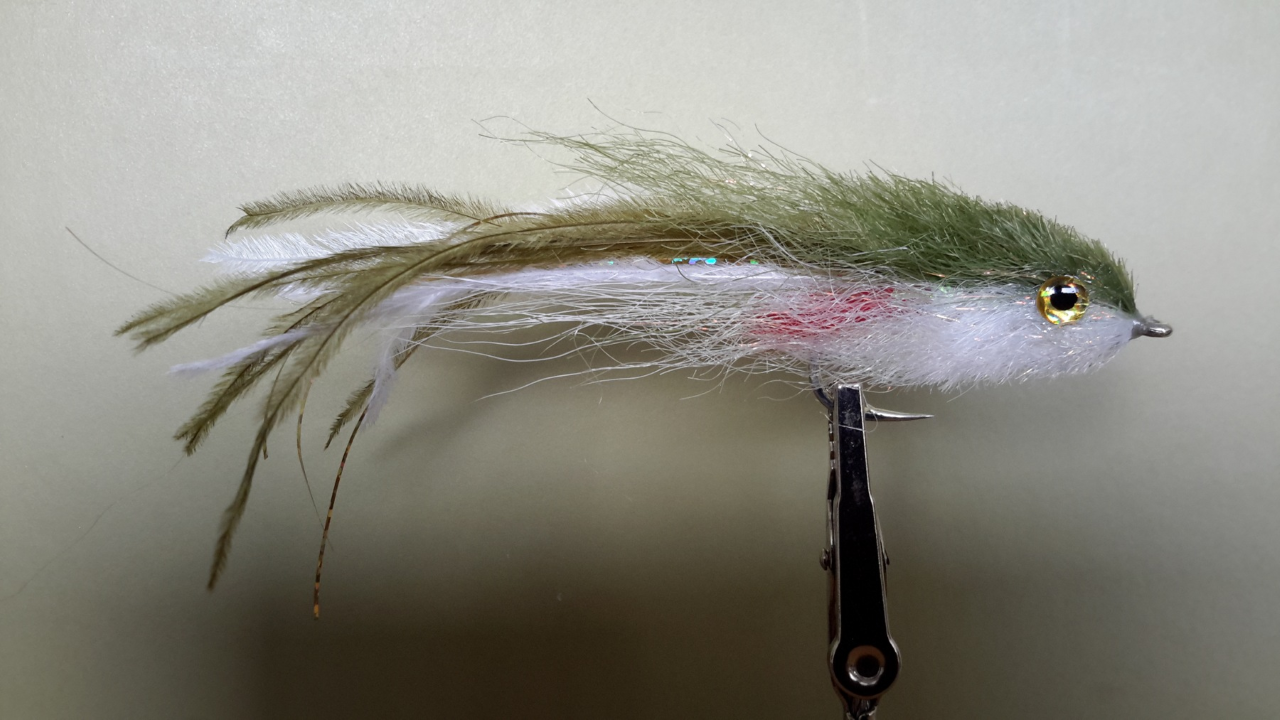
Bart Landwehr's Bart-O Minnow

 - hook: standard lenght saltwater hook. I use a Mustad C70S #2/0;
  - thread: I use white 6/0 uni until I've tied in the throat and then fine mono;
  - tail: tied between barb and point, about 2 1/2 to 3" long: white bucktail under 4 white ostrich herl under  4 gold Flashabou strands under 7-9 olive ostrich herls. In the original it's Icelandic Sheep hair instead of ostrich herls;
  - throat (??) (not tied at the head of the fly as usual but at the tie-in point of the tail ): red rabbit hair about 1/2" long;
  - under body/head: pearl crystal chenille wrapped from tail to just behind hook eye;
  - body/head: white SF Flash Blend under and on the sides of the shank and olive Flash Blend under. From tie in point of tail to behind hook eye. About 4 pinches each color  tied hi-tie style and then the last pinch of each color tied hollow-tie (reverse-tie) style just behind the eye of the hook. With the first pinch of each color flowing back to about half the lenght of the tail and each subsequent pinch about half the lenght of the previous one. And, on each side of the shank to cover it , I add one sparse pinch of white blend at the midway point and the same with the hollow-tie at the front but these pinches are tied the standard way and not hi-tied or hollow-tied.
In the original, the body/head was initially made with Angel Hair using the loop-spin-wrap method;
but then Landwehr's switched to EP Sparkle brushes. But I wanted a dark back and light belly for this baitfish imitation and anyway I hate the loop-spin-wrap;
  - eyes:3D molded, gold, 1/4". I use a drop of E6000 to glue them in and then cover them with Liquid Fusion.
 
The original also calls for a collar of white Ice Fur just after putting in the throat but with the rear of the Flash Blend body extending over the tail, this collar is superfluous.
 
also tied  in chartreuse/white, chartreuse/yellow and gray/white (that's the color scheme of the original) but the olive/white was the first I tried and it worked so well that the others remained in my boxes! Hopefully I'll get around to try them this coming summer  


Friday, February 22, 2019

Al Q's "Holy Moley" Sand Crab pattern

he's got it out on his blog, and I don't want to plagiarize, but this looks like a great pattern!

Al Quattrocchi

Al is a big time chaser of corbina, but also has an interest in a variety of species and fly fishing in general.

https://alquattrocchi.wordpress.com/2018/07/18/qs-holy-moley-sand-crab/


Wednesday, February 21, 2018

Ultra Shrimp

Here is a version of Bob Popovics Ultra Shrimp

Ultra Hair, Pink Hackle, 1/0, mono eyes, Loon U/V thin/thick for the shell


Wednesday, February 14, 2018

The Betsy

My versions (still in need of some trimming) of Bonefishdick's (yeah, look him up :) ) fly
titled "The Betsy"

There is enough info "out there" on Dr. Google for you to follow.

For now:


I also tied a black version.

These use ultra hair for the tail and collar, Farrar blend for the body.

Blue and White use florofiber for the throat.

Can't wait to fish them!

Saturday, February 22, 2014

Baby Flounder Fly?

looks good, I'll sub fox tail for the "coyote" hair though...

Pheasant Phlounder


Hook:  #2 Tiemco 811S or 800S
Thread:  3/0 Monocord, brown or tan
Eyes:  small or medium lead dumbbell eyes, tied in 1/3 of the way back from the hook eye
1st Wing:  cream or tan coyote guard hairs from the belly or tail, pushed down to have a flattened appearance
1st Collar:  two mottled grayish-blue pheasant feathers followed by a 3rd pheasant feather of a brownish coloration, the 1st being the smallest of the 3 feathers, tied in back of the lead eyes and wrapped – the fibers should be gathered and tied in a “beard” style so that all the fibers are on the hook point side of the shank
2nd Wing:  brown or tan coyote guard hairs from the belly or tail, pushed down to have a flattened appearance
2nd Collar:  a brown marabou-like pheasant feather, followed by a smaller golden-brown pheasant feather, tied in front of the lead eyes and wrapped – the fibers should be gathered and tied in a “beard” style so that all the fibers are on the hook point side of the shank
Note:  Any pheasant feather or other plumage (including feathers from a hen pheasant, grouse, dyed partridges or roosters or hens) may be used so long as they are reflective of the natural coloration of a juvenile flatfish.

Step 1

Using brown or tan 3/0 Monocord and a #4 – #1 standard shank hook, tie in a set of small or medium dumbbell eyes with figure-eight wraps, two eye lengths back from the hook eye. 

Step 2

Tie in a bunch of tan or cream coyote tail or grey fox tail guard hairs as long as twice the hook length or slightly longer on the hook point side of the shank, two eye lengths in back of the lead eyes.  Guard hairs with dark tips are acceptable.  Tie the guard hairs in with two or three loose wraps and then flatten the fibers down with thumb pressure.  Trim the butts and continue to bind the guard hairs down with at least 6 tight turns.

Step 3

Attach the first of three pheasant body feathers at the coyote hair tie-in point.  Wrap the feather forward (you will only get two or three turns out of the feather due to its small size) and tie down.  Form a beard by grabbing the pheasant fibers and pulling them down under (hook point side) the hook shank and tying them down.  Flatten the fibers with thumb pressure and secure the fibers in place.  Trim out any fibers that would not swing around to the hook point side of the shank.  Repeat (3 or so feathers) with increasingly larger feathers until you are tight to the lead eyes.

Step 4

Tie in another bunch of tan or cream coyote tail or grey fox tail guard hairs on the hook point side of the shank directly in front of the lead eyes.  The hair should only go to the length of the bend or slightly beyond.  Again, tie the guard hairs in with two or three loose wraps and then flatten the fibers down with thumb pressure.  Trim the butts and continue to bind the guard hairs down with at least 6 tight turns making sure that you don’t build any thread bulk near the hook eye.

Step 5

Attach the first of two pheasant body feathers at the coyote hair tie-in point.  The first feather should be slightly larger than the other feathers you have selected and should have a marabou-like quality of fluff on the first thin section of stem.  Wrap the feather forward (you will only get three or four turns out of the feather due to its small size) and tie down.  Form a beard by grabbing the pheasant fibers and pulling them down under (hook point side) the hook shank and tying them down.  Flatten the fibers with thumb pressure and secure the fibers in place.  Trim out any fibers that would not swing around to the hook point side of the shank.  Repeat with a smaller, less fluffy feather until you are tight to the hook eye.

Step 6

Whip finish and apply head cement to the entire bottom portion of the flounder (lead eyes, exposed feather stems and head).

Thursday, December 12, 2013

Another Mole Crab Pattern - Skok's Blind Crab

tied with orange "underneath"

Skok's Blind Crab

A few thoughtful changes transform a bonefish fly into a mole crab pattern

Mole crabs (Emerita talpoida), also known as sand fleas, are common along the shorelines of oceans and bays throughout the Atlantic seaboard from Cape Cod to central Florida. These small, clawless olive-shaped crabs spend most of their time hiding in the sand right along the surf. Sometimes you'll see them on the beach scurrying for cover, but distinctive ripples in the sand also indicate where colonies of crabs have buried themselves.
Opportunities to seize this prey are brief, so predators have to move slowly and focus intently to find and capture them. Presenting a fly to fish that are homed in on these unusual crabs creates a unique sight-casting situation. The most effective method is to get the fly well in front of the fish, allow the pattern to settle to the bottom, and then bring it to life with a short strip to attract the fish's attention. Refrain from moving the fly too much - you want to make subtle hops and twitches interspersed with brief pauses, much like when bonefishing.
While there are several mole crab patterns, a recent Dave Skok adaptation of Bailey and Pallot's classic Bonefish Bunny, which he calls the Blind Crab, is the best one I've fished yet. It's a rabbit-fur fly that rides point up with a shock of rubber legs out the tail, and it has proven itself on many Northeast flats and beaches.

Last September I had a chance to fish the infamous flat adjacent to the Oak Bluffs ferryboat dock on Martha's Vineyard. These "downtown stripers" have undoubtedly seen more lures and flies than I have, and since they have Sea World-like living conditions, local legend is that they are impossible to catch.
A gallery of 25 onlookers gathered as I descended the stairs to the beach. I felt pressure - the heat of 50 eyes that had seen many cocky anglers embark on this march to modesty. It's amazing what you'll pull out of your fly box in moments like this - I went with Skok's brand-new crab pattern, which was totally unproven at the time. That's how much I respect him; he's clearly one of the best saltwater tiers today.
MATERIALS
Hook:  #1 Mustad Signature C68S SS
Thread: Shell-pink flat-waxed nylon and tan 3/0 Monocord
Eyes: Medium lead dumbbell eyes (can be painted tan, cream or orange)
Tail: Bleached elk hair
Legs: Size M cream Span-Flex, barred pale pink and black with permanent markers
Underbody: One strand of tan E-Z Bug or Bill's Woolly Bugger Marabou Chenille and a ginger variant (or other color) saddle hackle
Carapace: Natural hare's ear magnum-
cut zonker strip
Glue: Head cement
As I stepped into the water I heard murmuring, snickers and a cranky-sounding, "You'll never catch 'em, sonny." I had a few choice words for that person, and after I took three 27-inch fish on successive presentations, those words were "Skok's Blind Crab."


Tying Instructions

Step 1:  Attach the eyes with the pink thread about 1/3 of the way down the shank, Clouser Deep Minnow-style on the top of the hook.


Step 2:  Lay a base of thread down the length of the hook shank, then tie in a clump of bleached elk hair behind the eyes and wrap over the hair down the length of the shank and slightly down on the bend so that hair points up when the fly is inverted. The elk hair should extend at least 1/2 inch past the last thread wrap. After the elk hair, tie in four strands of premarked Span-Flex. These should be about as long as the elk hair, but trim the outside two strands slightly shorter than the center strands.


Step 3:  Tie in about 4 inches of a single strand of tan E-Z Bug Chenille and a single thin-stemmed ginger saddle hackle at the bend.


Step 4:  Wrap the chenille and the hackle together (bumblebee-style) all the way to the eyes. Do not wrap the chenille first and then attempt to palmer the hackle over it - the hackle stem will trap the strands of the fuzzy chenille and leave an unfinished appearance. Flip the fly over in the vise and trim the hook-point side of the materials flat. Whip-finish and apply head cement to the trimmed chenille/hackle and the exposed thread around the eyes.


Step 5:  Start the tan thread in front of the eyes. Poke the hook point through the hide of the zonker strip so that the hair flows rearward and tie it in just in front of the eyes. Leave about 1/3 inch of hide hanging behind the bend. Pull the hide taut and trim it at the appropriate length. Cut off the square tips at the forward end, just behind the tie-in point, to help create a smooth, tapered head. Whip-finish and apply head cement.

Mole Crab Pattern - Tying over the winter

Well, looks like another year of fishing is wrapped up, cold weather has socked in.


I'll be tying up some crab patterns, and starting with mole crabs, very prevalent in the surf in our area: Thread: 6/0 Uni Tan 
Hook: Gama SC15 1/0 
Tail: Badger Hackle -tip trimmed. 
Mouth Parts: 3-4 strands Pple Krystal Flash over White BT. 
Body: Dub Loop: Back 1/2-Hareline Dubbin-White; Front 1/2-UV Hot Orange. 
Collar/Legs: 1/2 of a Light Blue Mallard Flank. 
Wing/Carapace: Light barred Mallard flank over Dark Barred Mallard flank. Flexament. 

These would be fished over a "light" colored sandy substrate.